Manufacturing · Unified systemCustomer story
Allergy-safe apparel maker puts its departments on one system with lot-level traceability
60%daily users one month after go-live
Manufacturing · Unified systemCustomer story
60%daily users one month after go-live
The company makes allergy-safe clothing for customers with sensitive skin and sells it through major online marketplaces and wholesale partners in markets across North America, Europe and Asia-Pacific. That promise sets a quality bar most apparel makers never have to clear: when a customer reports a skin reaction, the company has to trace it back to the exact production batch, the fabric lot and the quality assessment it passed. Production runs out of a single facility, one the company is already planning to scale.
The company ran on spreadsheets and paper slips. They carried thousands of SKUs, purchase orders, quality records and job orders between departments, every step recorded by hand with no digital trail behind it. To manage multiple active SKUs across product development, production, quality, supply chain, sales and accounting, the existing process was unsustainable as they scaled. Each department that touched a file described the same material a different way. One fabric could carry one code in the material list and a second code on a production sheet, depending on who entered it.
That made traceability, the company's central quality requirement, slow and manual. Tracing a single customer complaint back to its production batch meant chasing down whichever paper slip and spreadsheet still existed for that run.
The same problem showed up in forecasting. The sales team ran a rolling monthly demand forecast by hand, without the sales history that makes a forecast reliable. Nothing then converted an approved forecast into a material order with the right lead time, so finished goods missed shipping windows regardless of how close the forecast was.
Off-the-shelf, packaged ERP is the obvious alternative for a company in this position, and it does not fit here. Unit conversions differ in every department on the factory floor, and a generic system will assume one standard unit throughout. Lot-level traceability, tracing a finished garment back to its fabric, its batch and the quality check it passed, had to sit inside the core data model, not get bolted on as a report. The bill-of-materials structure spans thousands of SKUs with specification fields specific to this factory's own process, and the company's existing records were too inconsistent to migrate cleanly into a generic template regardless.
thinkbridge proposed a system modeled on how this factory actually runs. Work began with a cross-department discovery to map the operation in detail, and the build followed from what that discovery found.
thinkbridge ran discovery sessions with every department: product development, supply chain, production, quality, sales and marketing, and accounting. Each session mapped the existing process before a specification was written. Discovery ran for about a month at the start of the engagement.
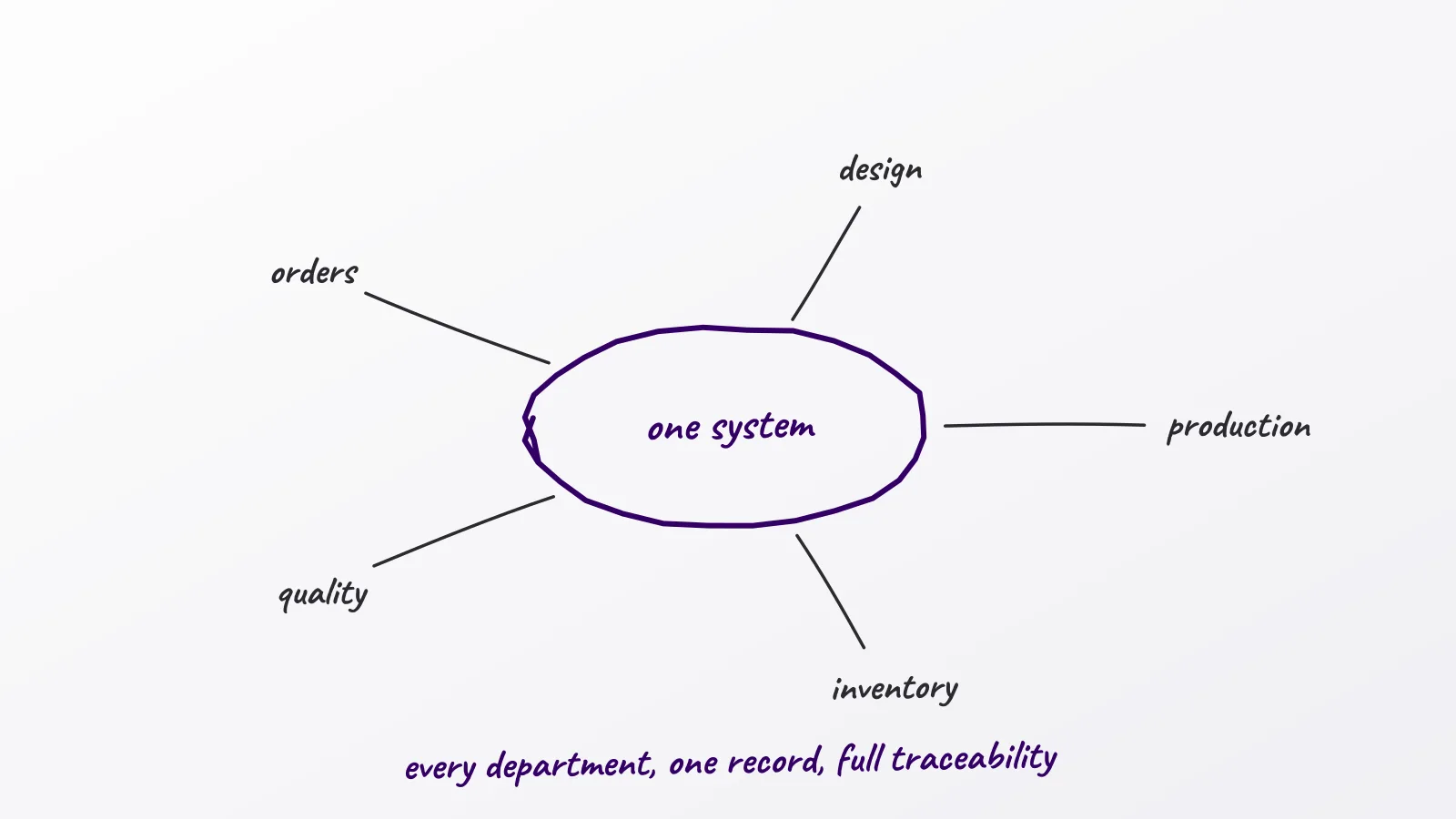
The build, delivered with thinkOne, covers nine role-based portals spanning the full operation: style and SKU development, supplier purchase orders, production tracking, quality checks, shipping and accounting. Every material and finished good is tracked by lot, from receipt through each production step to shipment, giving the quality team a direct trace from any finished garment back to its fabric and its production run.
The forecast proved to be the actual challenge. The company had never kept the sales history a trend-based forecast runs on. thinkbridge built the system to start capturing that history from the first order forward, so an approved sales forecast now generates a material requirement plan and supplier purchase orders on its own. The model runs on the assumptions the company's own sales team can defend today, and it sharpens as a genuine trend line builds behind it.
thinkbridge trained each department's team during a supervised soft launch, which ran for the month before go-live, then took the system live in August 2026.
60% of the roles the system was built for were working in it every day within a month of go-live. These are the department leads and platform users across all nine portals, measured in September 2026. There was no software habit to build on: teams that had never worked from anything but paper and spreadsheets moved onto one platform within weeks, not over a slow, multi-quarter rollout.
Every lot received since go-live traces automatically. A quality inquiry that once meant a manual search through paper slips now traces to a batch, a fabric lot and a quality assessment directly inside the system. Lots received before go-live are still being migrated into that same record.
An approved sales forecast now generates a material requirement plan and supplier purchase orders on its own, without the manual re-analysis each department used to repeat separately resulting in shorter forecast-to-PO cycle and fewer missed shipping windows.
The company is still running a handful of legacy processes in parallel while it finishes migrating historical traceability records and smoothing hand-offs between departments. thinkbridge is continuously working with the company to provide managed care ensuring post-deployment fixes, workflow improvements and feature additions as they scale.
Tell us what is holding your operations together. thinkbridge will show you what it looks like built right.